This essay by Dr. S. Frederick Starr was written for the meeting of the World Society for the Study, Preservation, and Popularization of the Culture of Uzbekistan, a body that has brought together Uzbek-sourced manuscripts from all the world’s museums. It has sent teams to the US, France, Germany, Turkey, and Japan, and has vastly expanded the known body of manuscripts from Central Asia, publishing them online and in print editions of superior quality. Dr. Starr has been a trustee since its founding in 2017.
He penned the essay hoping to push the Society and the new Center for Islamic Civilization in Uzbekistan to expand their scope to include—and engage with—all of Central Asia.
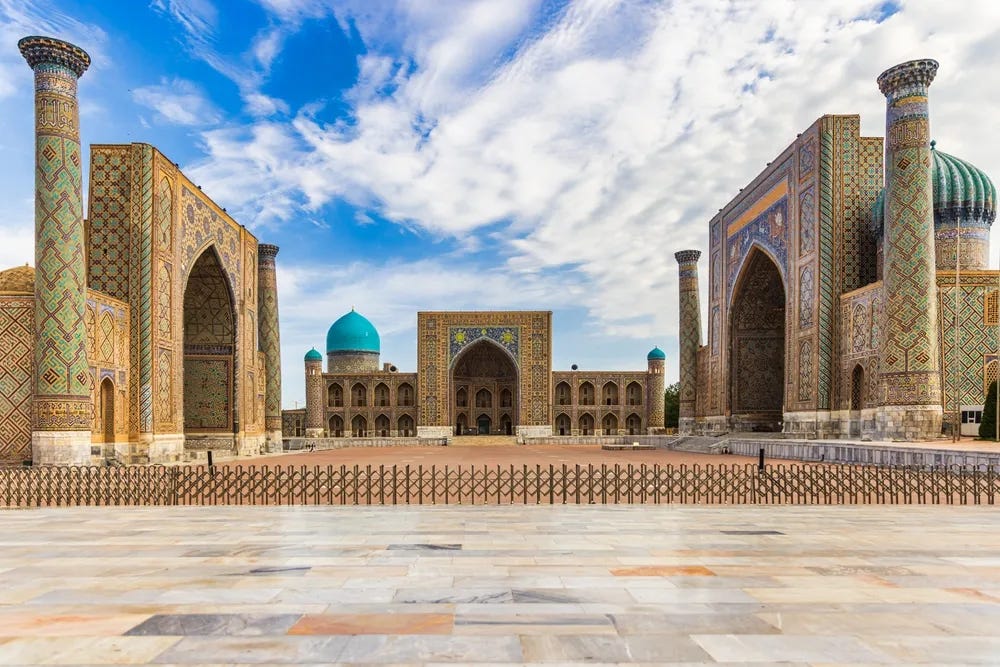
Photo source: Framalicious
We confront today a truly enormous topic: the culture of the Timurid world. The number of fields in which significant achievements took place between Timur’s return from his conquests and the rise of the Uzbek Muhammad Shaybani is staggering: literature, the writing of history, miniature painting, bookbinding, poetry, architecture, calligraphy, philology, astronomy, metallurgy, manufacturing, linguistics, mathematics, architecture, music, theater, pharmacology, medicine, music, urban planning, and so forth. The list is nearly infinite. And yet, in spite of generations of serious scholarship, many of these areas have scarcely been touched.
Take, for example, the giant figure of Ali Shir Navoi, the Persian-speaking native of what is now Afghanistan who, paradoxically, became the father of Chagatai Turkish. It was his good fortune to have been a schoolmate of the future Sultan Hussein Baykara, the son of Shah Rukh. This, along with his immense native talent, assured for him a senior position under Shah Rukh. While he penned wonderful verses in both Persian and Turkic and was lauded as a man of letters, he also carried out a range of other responsibilities, among them the commissioning and oversight on the construction of many of the most important buildings erected in and around Herat in the Timurid era. These included madrassas, libraries, hospitals, and caravanserais. Though Navoi was a manager and not an architect, he gave rise to the octagonal and richly ornamented tomb of the thirteenth century poet Attar in Nishapur. Yet who has examined these diverse structures to identify common features that might reflect the degree of central control over their design and hence of Navai’s direct or indirect role?
To take another example, one of the most glorious achievements of the Timurid era was the system of madrassas established by Ulugh Beg, which marked a radical break with Central Asia’s educational past and, at least in potential, the start of a new and more modern era. Of course, we know that the curriculum at these institutions featured solid doses of mathematics and science. But we still lack details on what was taught, how it was taught, and whether or not these innovative institutions had any progeny elsewhere in Central Asia.
To take yet a third topic that demands further research, we know a lot about Timur’s Samarkand, about the rise, fall, and rise again of the immense Bibi-Khanym mosque and other monumental buildings there. Yet we know surprisingly little about the design and character of one of the earliest Timurid complexes, namely, his Ak-Sarai in Kesh, now Shakhrsabz. Construction on this overwhelming monument began when Timur was still in his forties, fully a generation before he launched work on the Bibi-Khanym mosque. Though never completed, it featured an arcaded courtyard, a formal water basin measuring 125 by 150 meters, and the immense thirty-eight meter-high main gate, which still stands today. Abdullah Khan of Bukhara demolished most of the complex in the sixteenth century, and even today neither the main structure nor the gardens have been explored archaeologically.
Rather than wallow further in the “known unknowns” of the vast panorama of Timurid culture, let us turn to the political and economic environment in which that culture flourished, specifically to the geopolitical context of the years between Timur’s return from his campaign in the Caucasus, Anatolia, and the Middle East and the rise of the Uzbek Muhammad Shaybani. I am fully aware that reasonable people may disagree with some of my generalizations or amend them fundamentally. My purpose is not to offer definitive truths but to set down a few of the spheres in which we should be working towards syntheses and relating those syntheses to our understanding of the culture of the era as a whole.
First, let me note the obvious: that in spite of our focus on Timurid Samarkand, the geographical scope of Timurid culture is enormous, extending at the very least from Mashad and deeper into Persia in the west, to the Tienshan, and from the Hindukush northward to Khwarazm, whose impetuous shah gave rise to Genghis Khan’s first incursion into Central Asia. But even this vast area covers only part of the picture, since the Mongol conquests extended much further within Central Asia alone. Remember too, that this was a borderless world. And as we speak of Timurid culture do we include all its diverse geographical sources, or the region which that culture eventually impacted?
Further complicating our task in defining the context of Timurid culture is the fact that while Timur was good at conquering, he (and his successors) were far more interested in extracting wealth from areas he had subdued than on state-building per se. Indeed, with the brief exception of Shah Rukh there really was no Timurid state in the modern sense of the term. What existed instead was an agglomeration of tribute paying cities separated by open desert spanning what the historian Sharaf al Din Yazdi called “Turan.” Though Turkic and Persianate people and their languages were predominant, there was no single dominant ethnicity, language, or culture. And while one can indeed trace certain strains of influence from the periphery to the center or centers, Timurid culture largely radiated outward from the two dominant centers, Herat and Samarkand.
Viewing the products of Timurid culture in literature, the arts, sciences, and architecture, one tends naturally to trace both their forms and contents to Turkic or Persianate sources. Yet to a degree that is not adequately appreciated, the Timurid world retained important features of its Mongol heritage. After the Chagatai ulus split between east and west, that is, between East Turkestan and Semireche, both sides continued important elements of Mongol rule. Thus, Timur deferred to tradition when he handed much of his administration to warlike Mongol officials, who continued over several generations to collect the taxes. Timur and his successors abandoned the tradition of selecting successors at tribal gatherings but actual succession continued along Mongol lines and, as under earlier Mongol rule, bitter conflicts arose among the contending factions. The Barlas tribe abandoned nomadism, became Turkified, and adopted Islam, yet Timur’s first move was typically Mongol in that he married the sister of the ruler of Balkh, which he then proceeded to conquer.
As you know, Mirza Muhammad Taraghay did not earn his honorific title through achievements on the battlefield. Yes, he defeated Shir Muhammad of Moghulistan, yet Shir Muhammad remained in power. And his own protégé, Baraq of the Golden Horde, laid claim to large territories in what is now Kazakhstan and Kyrgyzstan, defeating the much larger Timurid army that marched up from Samarkand. Mirza Muhammad Taraghay then attempted to fortify his entire northern and eastern border, even starting the construction of a circular fortress on the Issyk Kul, which has recently been explored by a team from the National Geographic Society in Washington. All this led to naught, and justified Shah Rukh to move the capital from Samarkand to Herat. But even this did not put an end to the intra-family conflict typical of the Mongols, with Ulugh Beg seeking a stronger voice in Herat. When Shah Rukh finally died, Ulugh Beg made a vain move on Herat but gave up. Samarkand’s golden age after Timur’s death was thus a period when culture and science substituted for failures on the political front. Its ruler and his elite had lost their political and military roles and instead indulged their resources in culture.
But what of the military and political situation in Shah Rukh’s Herat? Timur named Shah Rukh governor of Khorasan at the tender age of twenty and he immediately faced both external and internal challenges. The external crisis arose from the fact that the entire western zone of the territory Timur bequeathed him, including Mesopotamia and the Caucasus, simply refused to accept his rule. When he finally defeated Turkoman forces, he hauled back to Herat a band of calligraphers and painters. Meanwhile, in typical Mongol style, close relatives continued to pose serious internal threats to his rule, with several of them mounting military campaigns against him that continued down to his thirty-second year. Only then did Shah Rukh achieve enough power to rule effectively. But even then he still had to contend with religious dissent in the form of the Hurufis, a Sufi sect whose founder Timur had executed and who, a generation later, attempted to assassinate Timur’s son and heir, Shah Rukh.
While acknowledging Shah Rukh’s eventual successes on the battlefield and his achievement of domestic control, it was above all his focus on the economy that underpinned the cultural boom in Herat. In typical Mongol fashion he focused on reopening the corridors of trade, which he did with signal success, and then on taxing the goods thus traded. This gave a talented band of administrators the resources needed to rebuild cities from Urgench to Mashad and for an equally talented group of cultural entrepreneurs (including one of his wives, Gawhar Shad) the money needed to adorn Herat with a series of mosques, educational establishments, and other monuments that rivalled his father’s projects in Samarkand. And his focus on trade and commerce facilitated the arrival in Herat of scores of artists, architects, poets, and other culture makers from across Central Asia and beyond.
Turning now to the Timurid achievement as a whole, we come face to face with several striking features. First, with the exception of the latter part of Shah Rukh’s rule, there was no Timurid state in the modern sense of the term, and what existed was dominated by a few key viziers and managers with little or no input from anyone else. At its best, this arrangement succeeded in protecting and taxing trade, but it was riddled with internal dissent largely arising from Mongol-type intra- family tensions. It bore little resemblance to the kind of Muslim state sketched out by Al Farabi in the tenth century or to the contemporary states of the Renaissance West.
Second, this type state was fed initially by booty extracted from conquered people and only gradually and incompletely did trade supplant it, and this mainly in Herat, not Samarkand.
Third, all leaders of Timurid Central Asia were Sunni Muslims who adhered to the Hanafi school of jurisprudence, yet from the outset they were confronted by religious dissidents. Sufis figured prominently in Herat, yet it was radical Sufi dervishes who murdered Ulugh Beg. As early as 1405 Shah Rukh faced a Shiite uprising, even though it took another century before the Shiite revival culminated in Safavid Iran’s conversion to Shiism. Prominent among moderate Sunnis in both capitals were followers of the tenth century Abu Mansur al-Maturidi of Samarkand, among them Mir Ali Shir Navoi.
In spite of outward piety, court life in both Samarkand and Herat was suffused with a relaxed attitude towards laws of the faith, including the imbibing of wine and representation of the human figure in art. In this respect they continued the forgiving and mellow attitude towards the laws of the faith. In spite of all this, when Ulugh Beg was murdered he was said to have been en route to Mecca.
Fourth, the concentration of talented artists, craftsmen, and thinkers in both capital was initially the direct heritage of Timur’s conquests. However, over time the existence of royal libraries and ateliers and court patronage led to the emergence of locally born masters, among them the artist Kamal al-Din Bihzad and calligrapher Mir Ali Tabrizi, both of whom were connected with state institutions.
Comparisons have often been made between the Timurid culture and the culture of the Italian Renaissance. Acknowledging that the Renaissance that was initially centered in Tuscany began earlier and extended later than the Timurid explosion in the arts and culture, the comparison is nonetheless fruitful. On the one hand, patronage in Florence and other Italian centers was more diversified than in Herat or Samarkand, and hence more frontally competitive. On the other hand, though both movements were fed and stimulated by far-reaching trade contacts, the geographical range of the Central Asian cultural effervescence was broader and more diversified than in the Italian case. Beyond this, while the Italian Renaissance was infinitely challenged and enriched by the ubiquitous presence of ancient Roman models in the arts, literature, and science, the flowering of Timurid culture was far more present-minded and, one might say, in dialogue with itself.
To repeat, I offer these observations simply as “notes in passing,” as obiter dicta, to cite the Latin phrase. I would certainly hope that attendees at this conference might challenge them, supplement them, or offer alternatives. The main point, however should by this time be obvious: namely, that it no longer suffices simply to produce monographs on individual artists, writers, calligraphers, or scientists. Of course, these are absolutely essential, but over the past century the accumulation of detailed knowledge on Timurid culture has been so great that it is time to move toward synthesis.
The syntheses which we lack must be based on generalizations and bolder hypotheses than are current available. They must draw comparisons with the work of similar masters of the arts and sciences from other parts of the world. And they must draw conclusions, however tentative, on how each specific study relates to our understanding of Timurid culture as a whole. We are all fortunate to live at such a time, and can be assured that the results of this broadened and deepened enquiry not only will be exciting but will resonate far beyond these noble halls in Tashkent.
About the Author: S. Frederick Starr was the Founding Chairman of the Kennan Institute and is currently Chairman of the Central Asia-Caucasus Institute at the American Foreign Policy Council.