Publications

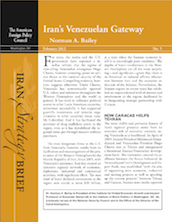
Iran Strategy Brief No. 4: Hezbollah’s Inroads Into The Western Hemisphere

August 23, 2011 Ilan I. Berman

A year after the attacks of September 11th, then-Deputy Secretary of State Richard Armitage, in contextualizing the terrorist threat facing the country, made a telling assessment. “Hezbollah may be the A-team of terrorists,” Mr. Armitage told an audience at the United States Institute of Peace in Washington, DC, “and maybe al-Qaida is actually the B-team.” The description was apt, and remains so. With a presence in an estimated forty countries on five different continents, the Lebanese Shi’ite militia represents one of the very few terrorist groups active today that possess a truly global presence and reach.

This footprint extends not only to the greater Middle East and Europe, but to the Western Hemisphere as well. Over the past quarter-century, Hezbollah has devoted considerable energy and resources to establishing an extensive network of operations throughout the Americas. Today, its web of activity in our hemisphere stretches from Canada to Argentina, and encompasses a wide range of illicit activities and criminal enterprises, from drug trafficking to recruitment to fundraising and training.

Toward An Economic Warfare Stategy Against Iran

May 31, 2010 Ilan I. Berman

America's strategy toward Iran is faltering. Nearly seven years after the disclosure of the Iranian regime’s nuclear program, and a year-and-a-half after the start of “engagement” on the part of the Obama administration, Washington has yet to see a substantive diplomatic breakthrough in the deepening international impasse over the Iranian regime’s nuclear ambitions. To the contrary, mounting evidence suggests that Iran’s rulers have used the strategic pause aff orded by American outreach to forge ahead with their nuclear endeavor, adding permanence to Iran’s increasingly mature and menacing atomic effort.

Multilateral eff orts at sanctions, meanwhile, have failed to keep pace with these advances. Between 2006 and 2008, three rounds of international sanctions were authorized and enacted by the United Nations Security Council, with little perceivable impact on Iran’s nuclear decisionmaking. A fourth round of sanctions has just been finalized by the United States and other Permanent Security Council members. Yet already, there are clear signs that this effort, like its predecessors, will fall far short of applying the broad, comprehensive economic pressure necessary for Iran to begin to rethink its nuclear drive.

As a result, the United States and its allies in the international community will soon be confronted by the stark binary choice best outlined by French President Nicolas Sarkozy several years ago: an Iran with the bomb, or the bombing of Iran. If it hopes to avoid such a state of affairs, the United States will need to marshal a comprehensive economic warfare strategy toward the Islamic Republic — one that leverages the latent vulnerabilities inherent in the Iranian economy to ratchet up the cost of the regime’s nuclear endeavor. Such an approach starts by focusing on six discrete areas of economic activity that could be used to alter the Iranian regime’s behavior.

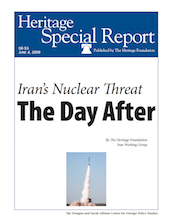
Iran’s Nuclear Threat: The Day After

June 4, 2009 Ilan I. Berman

Iran is on the brink of attaining a nuclear weapons capability. The U.S. should immediately put in place the foundations of a strategy to dissuade Tehran from attaining a nuclear weapon through diplomacy, disarm it through military force, or establish a robust framework of augmented deterrence to mitigate the threat posed by a nuclear Iran and prevent a future disaster from unfolding.

Iran Strategy Brief No. 3: The Case For Economic Warfare

January 29, 2008 Ilan I. Berman

What can the United States do about Iran? Today that question, fueled by growing international concern over the Islamic Republic’s persistent nuclear ambitions, has emerged at the forefront of the American strategic debate.

In this calculus, economic measures have received comparatively short shrift. This is because conventional wisdom has it that the United States possesses little leverage that it can bring to bear in order to deter and contain Iran’s nuclear ambitions. In this case, however, the conventional wisdom is wrong; the United States has a considerable number of economic tools at its disposal, despite its lack of trade relations with the Islamic Republic.

Confronting Iran: U.S. Options

November 14, 2007 Ilan I. Berman

Today, the Islamic Republic of Iran looms large on the agenda of policymakers in Washington. Over the past several years, it has become clear that the Islamic Republic is pursuing a massive, multifaceted endeavor to acquire a nuclear capability—and that it is making rapid progress toward this goal, despite pressure from the world community. Yet Iran’s nuclear program is just part of a larger picture. The Islamic Republic’s enduring support for terrorism, its growing and pernicious regional role, and its radical, uncompromising ideology currently also pose serious challenges to the United States, its allies and American interests in the greater Middle East.

So far, policymakers in Washington have failed to muster an adequate response on any of these fronts. As a result, the Islamic Republic has gained precious time to entrench itself in Iraq, expand its support for terrorists and bring added permanence to its nuclear effort. The logical conclusion of the current status quo is a mature Iranian nuclear capability, continued Coalition casualties in Iraq, and emboldened terrorist groups across the region. If it hopes to avoid such an outcome, the United States must harness all the elements of national power into a strategy that focuses on three concrete goals vis-à-vis Iran: counterproliferation, counterterrorism, and counterinsurgency.