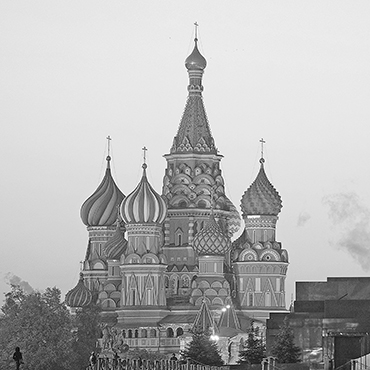
RUSSIA'S CRUMBLING STATE
For years, the Russian government has consistently attempted to portray itself as presiding over a modern, dynamic state. That has become harder to do since the start of the Kremlin's war on Ukraine in February 2022, which has progressively squeezed the country's economy and limited its commercial options. Yet officials in Moscow continue to paint a rosy picture of the overall state of the nation. Underneath these pronouncements, however, the very architecture of the country is aging – and eroding. Thus, writing in his Window on Eurasia blog, Paul Goble notes that one in every 15 buildings is now so old that – under national law – repairs are deemed "economically unfeasible." What that means, as a practical matter, is that millions of Russians now live "in a gray area where their residences have not yet been declared unsafe but... need repairs that the authorities are not willing to authorize because of the buildings' ages."
"Most of these aging buildings were erected in Soviet times with a projected lifespan of 25 to 30 years." Goble elaborates. "But many have remained occupied for as much as 60 years and haven't seen any major renovations for more than half a century. There simply isn't enough money budgeted or being collected from residents to change that." (Window on Eurasia, March 1, 2026)
RUSSIA SHARES INTEL WITH IRAN...
Over the past several years, the Islamic Republic of Iran has become a major participant in the Russian war on Ukraine. Since 2023, Tehran has aided the Kremlin by providing the Russian military with hundreds of Shahed drones for use against Ukrainian troops and population centers, and by overseeing the establishment of a production facility for more of the systems on Russian soil. Now that Iran finds itself embroiled in a conflict of its own, however, Moscow seems to be returning the favor.
According to the Wall Street Journal, Russia is providing Iran with satellite imagery and improved drone technology to support Iranian strikes against U.S. forces located in the Gulf states. The paper reports that Russia operates a fleet of satellites that provide intelligence for military operations, and is passing data on to Iran the locations of U.S. military forces and its regional allies. As a result of the increased intelligence sharing, Iran has begun targeting radar and command and control positions more intensively, following a pattern similar to Russian strikes in Ukraine. Analysts compare Russia's assistance to that which the U.S. and European allies have provided to Ukraine in recent years, while a White House spokesperson has denied that Russian intelligence is having a significant impact on the course of the conflict. (Wall Street Journal, March 17, 2026)
...AS IRANIAN DRONES HEAD IN THE OTHER DIRECTION
Intelligence may not be the only thing Moscow is sharing with the Islamic Republic, however. In a recent interview with CNN, Ukrainian President Volodymyr Zelenskyy claimed that the Kremlin is now assisting Iran's regime with its offensive capabilities in its unfolding confrontation with the United States and Israel. it was "100% facts," he said, that Iran was using Russian-made Shahed drones to attack the State of Israel as well as U.S. bases in the Middle East. (Reuters, March 15, 2026)
NETWORK OF "DISPOSABLE AGENTS" CONDUCTS SABOTAGE IN EUROPE
Moscow is employing "disposable agents" to conduct acts of sabotage in Europe, a new expose by Serbian news outlet NIN documents. Under the scheme, Russia targets economically or socially disenfranchised people, often Russians or Ukrainians living in Europe, and offers them small sums of money to execute sabotage operations. Recruiters often operate on social networks, especially Telegram. Currently, German and Romanian authorities are investigating cases of sabotage conducted by Russian disposable agents, the NIN report details. (NIN.rs, March 17, 2026)
FSB EXPANDS ELITE PROTECTION
Since the start of the war in Ukraine four years ago, a large number of high-ranking Russian military officials have been assassinated, with Ukrainian military intelligence taking responsibility for most of the incidents. As these killings have taken place, worries have risen about the safety of key Russian political figures – chief among them President Vladimir Putin himself. In response, FSB chief Alexander Bortnikov has announced that the Russian internal security agency is planning to significantly increase its physical protection for high-profile individuals involved in the Ukraine war. (Al-Arabiya, March 19, 2026)
[EDITORS' NOTE: It is as yet unclear what prompted Bortnikov's belated announcement. However, it is likely driven either by fresh intelligence about Ukrainian targeting of Russian officials, or by growing popular dissatisfaction with domestic conditions brought about by Putin's handling of the war so far – or both.]
Want these sent to your inbox?
Subscribe
Russia Policy Monitor No. 2721
Related Categories:
Intelligence and Counterintelligence; Military Innovation; Warfare; Corruption; Iran; Russia; Ukraine