Why Russia’s War With Ukraine Is Actually a Global Conflict
Sometimes, it is said, in order to make a problem smaller, you need to make it bigger first. So it is with the Ukraine war, which is now fast approaching its grim fourth anniversary.
Sometimes, it is said, in order to make a problem smaller, you need to make it bigger first. So it is with the Ukraine war, which is now fast approaching its grim fourth anniversary.
Sometimes, it is said, in order to make a problem smaller, you need to make it bigger first. So it is with the Ukraine war, which is now fast approaching its grim fourth anniversary
China criticizes, sanctions Japan over PM's Taiwan comments;
China builds the world's first floating artificial island;
UK set to approve new PRC mega embassy;
Amsterdam suspends Nexperia takeover;
Chinese stakes in Italy's energy grid raise red flags
Moscow recruits Africans... and others;
Belarussian prisoners forced to aid Russia's war;
Kremlin claims plot against Putin's spiritual advisor;
Kremlin worries about social cohesion;
Russia sources most ammunition from North Korea
Today’s Central Asian reformers are picking up and reviving neglected approaches to politics and society that Islam’s Golden Age turned its back on a millennium ago. They do so as Muslim believers or at least as officials respectful of Islam.
Over the past several years, China's information warfare capabilities have grown by leaps and bounds as Beijing has tapped into the disinformation expertise of its longstanding strategic partner, Russia.
But the most immediate target of Chinese messaging remains Taiwan. As officials and experts there made clear on a recent trip, the People's Republic of China's informational assault is changing—and intensifying.
Tit-for-tat among Ukraine's corruption watchdogs;
Kyiv contemplates becoming a drone exporter;
The murky status of military innovation;
Making military service more attractive
UN backs renewed talks on Morocco’s Western Sahara proposal;
UAE accused of supplying weapons to RSF;
Al-Qaeda-linked militants tighten fuel blockade;
The perils of Chinese mining;
Guinea seeks iron ore leverage
A new push for "morality";
Domestic repression deepens;
Iran expands missile capabilities;
Iranian investors eye the exits
China has invested $2.1 trillion in strategic sectors around the world;
MI5: PRC spies target UK lawmakers using LinkedIn;
Britain announces plan to counter PRC espionage;
China funds $29 million revamp of South African military base;
Beijing warns citizens of risks amid African gold rush

Let us build new alliances between scientists, sages, and storytellers — between Bengaluru and Be’er Sheva, between Jerusalem and New Delhi — to ensure our tools reflect our deepest values.
The Trump administration’s success in brokering the Armenia-Azerbaijan deal demonstrates what’s possible when the United States engages seriously in the region. As the TRIPP corridor begins development, American policymakers would do well to look beyond immediate economic opportunities to the strategic landscape taking shape around them. The Caucasus is no longer Russia’s exclusive domain. The South has transformed. The North may follow, with consequences extending far beyond Russia’s borders.
The taps are running dry in Tehran. Iran's capital is now experiencing a massive and deepening water shortage. After months of drought and scorching heat, the five reservoirs feeding the city of more than 10 million are mostly empty.

Although Tehran’s activities in Africa tend to receive far less attention than its machinations in the Middle East, Europe, or Latin America, they form a critical pillar of the Islamic Republic’s global strategy.
In a quiet room high in the Himalayas, I sat with a monarch attempting something almost unseen in our time: the peaceful reinvention of a nation. For hours, King Jigme Khesar Namgyel Wangchuck guided me through maps, water tables, demographic curves, and the architectural outlines of a city not yet built but already alive in his imagination.
Fruits of the recent ASEAN summit;
APEC summit wraps with U.S.-China trade trucel;
Japan's new prime minister hits the ground running;
Australia and U.S. strike critical-minerals deal;
Pakistan-India tensions spike anew after terror attacks
A recent week of meetings in Vietnam with Communist Party leaders, government officials, and other influential figures reveals how Hanoi views today’s economic and geopolitical challenges, as well as how Washington might reassure the country about its commitment to a deeper U.S.-Vietnam relationship after months of unhelpful friction between the two.
Beijing's AI-driven hacking campaign;
Trump-Xi meeting spurs agricultural deals;
China trade surplus with Germany hits new high;
China is a "very significant" challenge to German car companies;
Visa-free policy extended through 2026, Sweden added
Venezuela's Maduro seeks support... in Moscow, Beijing and Tehran;
Waning enthusiasm for the Ukraine war;
Russia green lights nuclear tests;
Poland plans to train civilians;
A growing domestic threat
On October 10, 2025, the CIS heads of state summit was held in Dushanbe, Tajikistan. Multiple packages of documents were signed, targeting trade, crime, and most importantly, security. Security challenges from Afghanistan, including extremism and border conflicts, have continued since the Taliban takeover, and these recent agreements make up another component of Central Asia’s lengthy efforts to reduce the recurring concerns that can potentially spill over into their territories.
Big changes are afoot in the South Caucasus. Back in August, in a move that passed largely unnoticed in the American press, the Trump administration pulled off a major diplomatic coup when it brought together Azerbaijani President Ilham Aliyev and Armenian Prime Minister Nikol Pashinyan to ink a joint declaration formally ending decades of hostility between the two regional rivals.
The Middle East is no longer asking whether it should develop domestic space capabilities; it’s deciding with whom it will develop them. If the United States wants to be the country of choice ahead of China, it must create a joint space partnership agreement framework to align American and partner nations’ industry, government and financial goals.
A regime stalwart who has long carried Putin’s water (and boosted his neo-imperial agenda), Lavrov has been conspicuously absent in recent days from a number of high-profile functions. The Foreign Minister, usually a fixture, failed to attend a meeting of Russia’s National Security Council on November 5th – purportedly “by agreement” (presumably with Putin). He was also cut out of Russia’s delegation to the upcoming G20 meeting in South Africa later this month, with a much more junior official, Deputy Chief of Staff Maxim Oreshkin, tapped to lead the Russian team instead.
Nigeria grapples with separatist protests...;
...As Trump threatens military action;
Tanzania's President declared election winner amid violent protests;
America eyes Liberia's critical minerals;
RSF takes key city of El Fasher from Sudanese military
Washington pushes Europe on Energy decoupling;
Ukraine's potential nuclear disaster;
Iran's water crisis... and its effects;
India's national rare earth strategy;
U.S., EU combat China's critical minerals control
Defunding RFA and VOA creates information void in Tibet;
Three PRC nationals arrested in Tbilisi for trying to buy uranium...;
...And three others busted for smuggling biological materials;
Chinese-made buses can be stopped remotely - Norway;
Xi commissions China's first supercarrier
Russia, China versus human rights;
Russia's revived Neo-Nazi movement;
Europe needs a new kind of defense against Russia, Estonia argues;
A different kind of Russian purge
For decades, the Kremlin has sought to intimidate foreign powers by threatening to use nuclear weapons. In the current Ukraine war, nuclear threats have been a key way by which Russia’s government has sought to restrain Western aid to Kyiv. The efficacy of Moscow’s nuclear brinksmanship, however, seems to be waning.
China's ambitious new AI+ plan;
One Chinese firm aims to expand autonomous van fleet...;
...While another debuts humanoid child;
Economic troubles persist;
Beijing urges vigilance against "irrational competition"
Back to a divided Yemen?;
Turkey is shaping Syria's future;
Pakistani Islamist party banned...again
Social media curbs in Denmark;
Moscow's propaganda demonizes Poland;
...And puts the Baltics on notice;
Iran: new internet restrictions at home...;
...And greater influence in broadcasting abroad
Rising gold prices grease Russia's war machine;
Europe's new plan for defense readiness;
How Moscow tried to subvert Moldova...;
...And is targeting Germany with hybrid tactics;
A Russian military upgrade
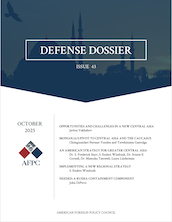
Opportunities and Challenges in A New Central Asia
Mongolia’s Pivot to Central Asia and the Caucasus
An American Strategy for Greater Central Asia
Implementing A New Regional Strategy
Needed: A Russia Containment Component
As rivals flood the world with propaganda, Washington is dismantling its best tools to respond.
Europe: A problematic dependence;
Trouble (for Moscow) in the Arctic;
Enemies, enemies everywhere
These days in Europe, there is a near-unanimous consensus about the threat posed by Russia and the need to continue to support Ukraine against Moscow’s aggression. But Europe’s steadfastness could be undermined by a different factor—a sustained and growing dependence on Russian energy among a number of its members.
Madagascar’s military seizes power after mass protests;
Congo trades export ban for cobalt quotas;
Russian forces fill the void as jihadists surge in Sahel;
Cameroon’s unrest grows
China purges top military officials;
China cracks down, arrests dozens of Christians;
Licensing deal for TikTok algorithm raises serious concerns;
Dutch government seizes PRC chipmaker Nexperia;
Despite China's threat's, UK delays China's mega-embassy again
Iran's new bargain with China: oil for arms;
New preparations for war...;
...And plans to militarize the Caspian;
Executions reach new high...;
...As legal penalties expand
Growing Russian military desertion;
A pivot away from the Mediterranean;
A mounting fuel crisis;
Freed Ukrainians count Russian torture
China continues to stockpile oil;
Beijing imposes more export controls on rare earths;
U.S. sanctions China refinery for Iran oil purchases;
China stops buying American soybeans;
BYD opens massive EV plant in Brazil
Islamists target Nigeria's Christians;
An ISIS resurgence in the Sahel;
Iran and the Palestinian arena;
After the ceasefire, a struggle for control
Sixty-eight years ago, the Soviet Union shocked the world by launching Sputnik 1 and igniting the space race. Today, new Sputnik moments loom on the horizon, and the stakes are far higher. The country that emerges as a preeminent space power will guarantee its own economic and national security, and shape the “rules of the road” that govern the international community for decades to come. Who will that be?
Nepal forms interim cabinet, sets elections;
Beijing considers research lab at Scarborough Shoal;
Pakistan and Saudi Arabia follow diplomacy with dollars;
Japan picks Takaichi as LDP leader, set to become first female PM;
North Korea's new weapon
After two years, the war in Gaza appears to be over. Following the Trump administration's active mediation last week, a tenuous ceasefire deal was struck over the weekend, and Israel's hostages have returned home. Of course, only time will tell whether this agreement will truly hold. Even so, it's not too early to draw some preliminary lessons from the conflict that just ended.
The plan relies on a future international force to dislodge the terror group, a scenario deemed highly unlikely. By failing to remove Hamas, the ceasefire merely sets the stage for the next inevitable war.
Sahel states quit the ICC;
Mutharika returns to power in Malawi;
Madagascar imposes curfew after protests;
Guinea approves new constitution;
China revamps Tanzania–Zambia railway;
Gen Z protests sweep Morocco
An AI race without Russia;
A Russian response to Europe's frozen assets plan;
Denmark warns of mounting Russian hybrid warfare;
Moscow helps Beijing prepare to seize Taiwan
The question is no longer whether SpaceX can deliver payloads into orbit; it is whether America’s present, profound dependence on this company could be politically weaponized in the future. The simmering summer-long feud between President Trump and Musk, which largely stemmed from the latter’s objections to the One Big Beautiful Bill Act and which saw access to SpaceX used as a key bargaining chip, suggests that the answer to this question is “yes.”